


AI and society
Artificial intelligence is not just a technical innovation: it is profoundly transforming our societies. By influencing decisions, freedoms and social equilibrium, it raises major questions. Bias, ethics, surveillance or environmental impact: this section invites us to understand these issues and to question the place we wish to give it.




Bias and discrimination
Bias and discrimination

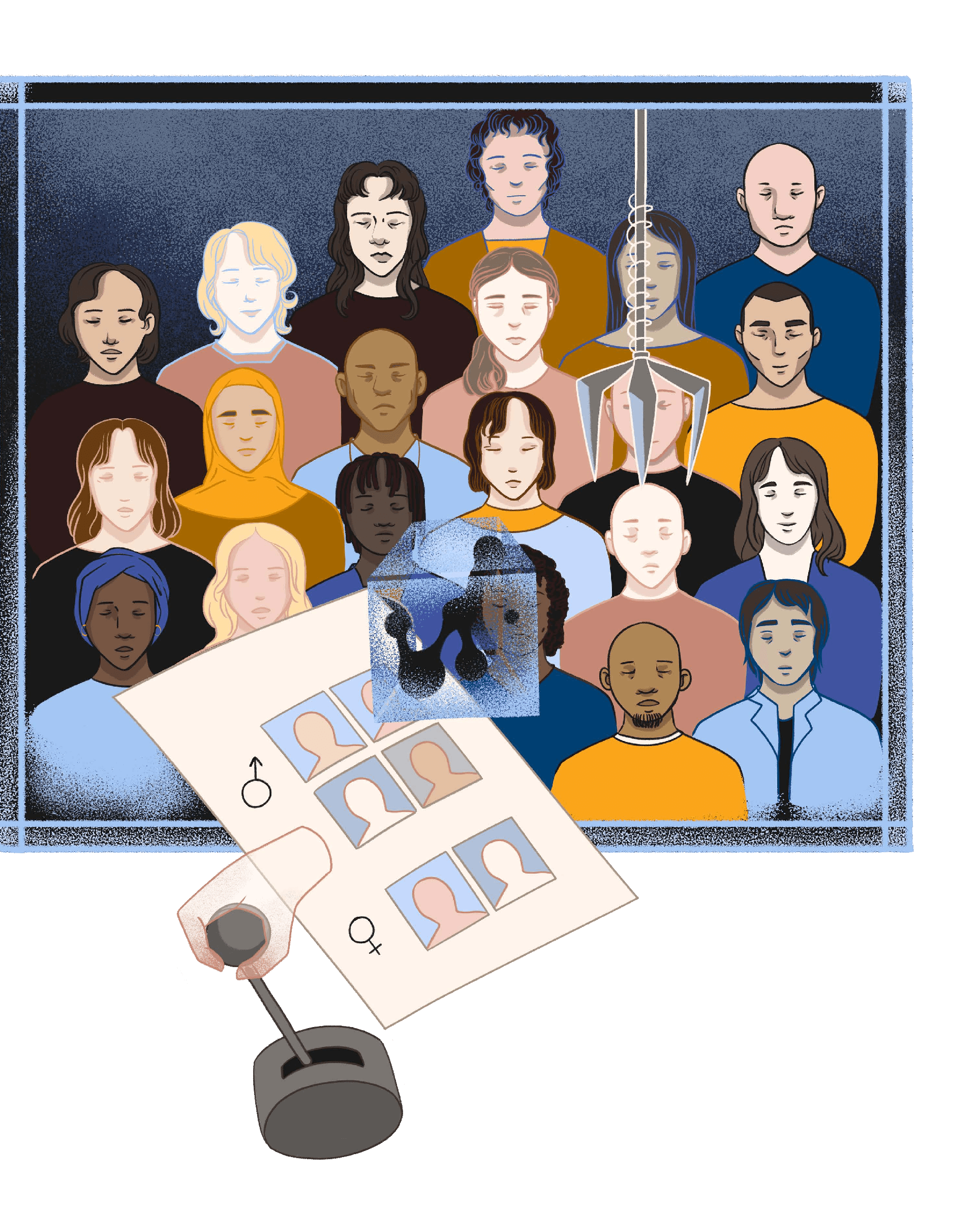
Artificial intelligence is structurally biased because it is trained on data that reflects the stereotypes and human inequalities. When this data is insufficiently diversified, the algorithms produce biased results, reinforcing discrimination against the most disadvantaged: women, racialized people, and, more broadly, minority groups.
This situation is exacerbated by the lack of diversity in the very design of AI models: according to a 2019 report by UNESCO, 85% of AI applications are developed by humans, which influences the technical choices made and the data used.
In healthcare, the lack of data from women or non-white people leads to less reliable diagnoses. Facial recognition systems also shows significant differences in performance depending on the person targeted.
In the mid-2010s, while the identification of fair-skinned men was 99% accurate, that of fair-skinned women was less accurate. The proportion of dark-skinned women fell to 35%.. The AI simply couldn't 'see' them correctly because it hadn't learned enough images of them.
To make AI more reliable, equitable and effective, it is essential to diversify both the training data and the profiles involved in designing the models.
Some models of generative AI are undergoing aintentional biasduring the alignment phase, aimed at making the responses of AI models more useful and reliable. A notable example is Grok, X's (ex-Twitter) chatbot, which was realigned after its initial launch to better match the views of the platform's CEO.