

AI for games
Playing, interacting, influencing. Since its very beginnings, gaming has been an ideal testing ground for AI research: learning to anticipate moves, adapting to complex environments or competing with humans. From board games to video games, AI enriches the gaming experience. But when it stops calculating and starts talking, convincing or manipulating, as in certain strategy games, a question emerges: how far do we accept a machine interacting with us?




AI versus human
AI versus human
From board games to video games, AI enriches the experience of players by creating larger universes and improving the quality of the game.

Since the beginnings of computing, games have been used to field of experimentation. From 1950, Claude Shannon explores an algorithm for playing chess, followed by Arthur Samuel who designed a draughts-playing programme for IBM.
Competitive two-person games (chess, draughts, go) are the most studied. They are often analysed using the famous MiniMax which evaluates the possible moves in the form of atree where each node represents a position on the board.
For complex games, this tree becomes too large; the alpha-beta pruning that allows unnecessary branches to be removed to optimise reflection.
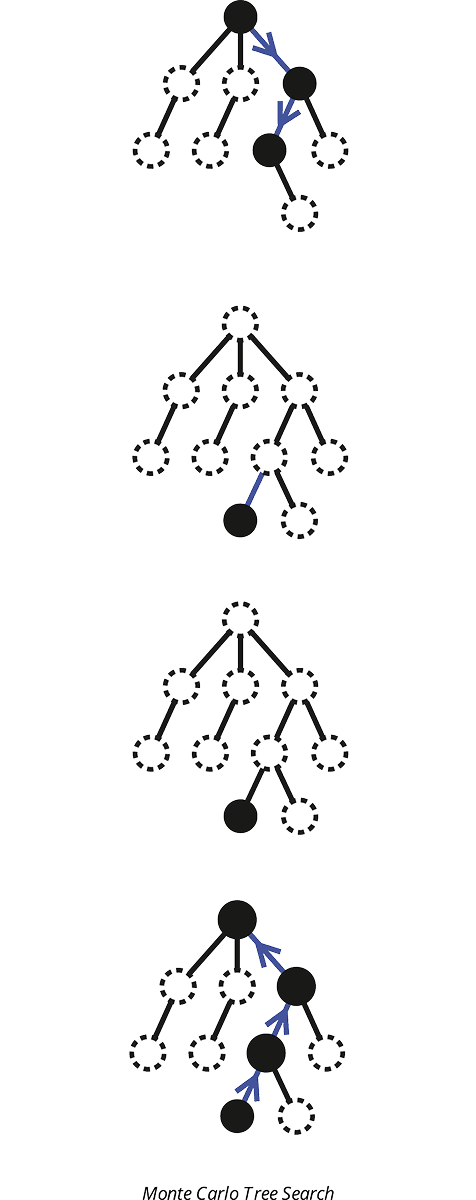
There are three main families of algorithms:
- Classic tree algorithms (such as alpha-beta).
- Monte Carlo Tree Searchwhich combines a game tree and random sampling.
- Reinforcement learning which is currently the most efficient.
This last method is revolutionary: the AI learns with no prior knowledge by playing thousands of games against itself discovering the winning strategies on her own.
In 2017 AlphaZero the basic rules of chess. Playing against itself, she went from beginner to unbeatable grandmaster in just 4 hours. In one morning, she rediscovered centuries of human chess theory.