


Histor'IA
Artificial intelligence was not created overnight: it is the fruit of decades of research, successes and challenges. Discover the milestones that have shaped its history.

The beginning
InitIAlement
The definition of artificial intelligence has always been the subject of debate, as the concept of "intelligence" remains complex. A commonly accepted definition is that "AI is a field of computer science aimed at developing systems capable of performing tasks usually requiring human faculties".
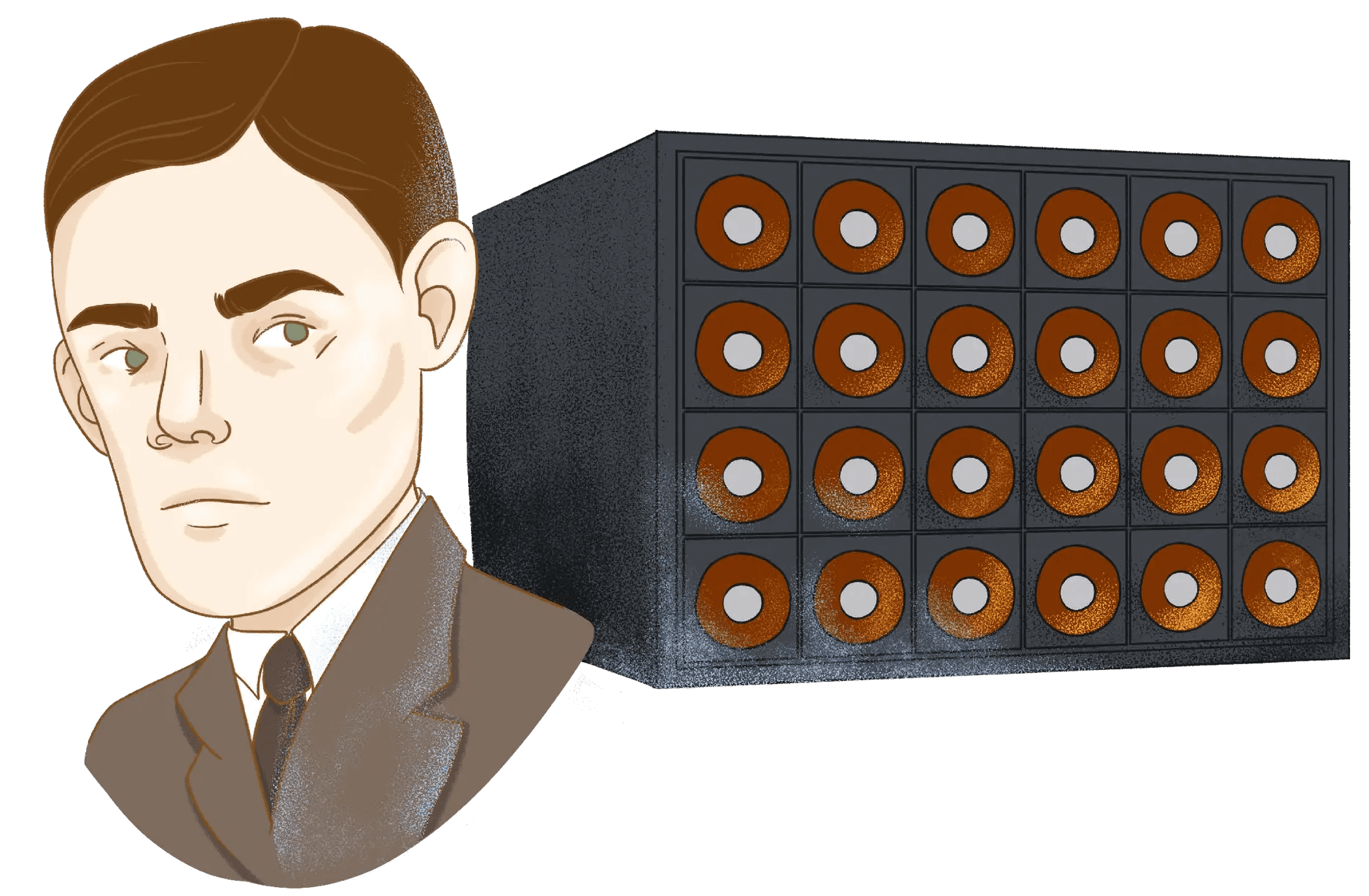
The Second World War is speeding up thinking about "thinking" machines, capable of imitating human intelligence. Alan Turing, now considered the father of computing, launched the famous Turing test, designed to assess a machine's ability to imitate human conversation. AI was officially born in 1956 at the Dartmouth Conference, which brought together the pioneers in the field.
The 1960s saw the birth of ambitious programmes such as the conversational agent ELIZA, programmed using simple rule-based logic such as: "IF 'hello' THEN reply 'hello'".
The ambitions of these programmes came up against the technological limitations of the time, as well as the first ethical and philosophical criticisms, giving rise to the first "AI winter".
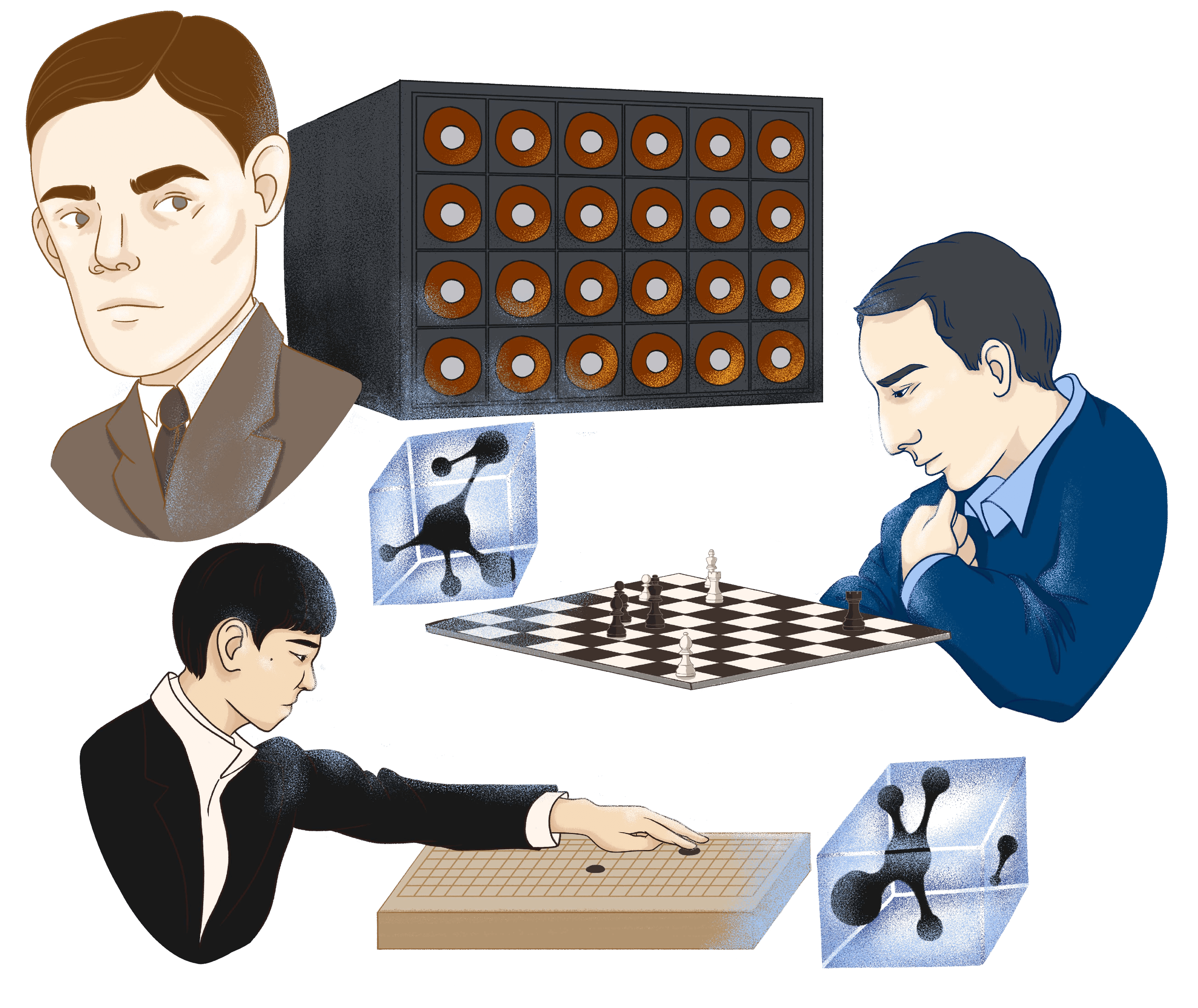
Success resumed in the 1990s with the rise of computing and, later, neural networks. In 1997, Deep Blue beat chess champion Garry Kasparovin. In 2005, Stanley met the challenge of autonomous vehicle; in 2011, Watson triumphed at Jeopardy!
Advances in deep learning (deep learning), a technology based on neural networks, are leading to the feat of AlphaGo at 2016 This will pave the way for generative AI models such as ChatGPT, which will be launched in 2022 and massively adopted by the general public.
The origins of artificial intelligence
1840-1950
1840: Ada Lovelace writes the first algorithm and anticipates the idea of thinking machines.
1936: Alan Turing writes "On Computable Numbers, with an Application to the Entscheidungsproblem" explaining the computational limits of an algorithm.
1943: Warren McCulloch and Walter Pitts publish a paper on formal neurons, establishing a link between neurology and mathematical logic.
1950: Alan Turing proposes the Turing Test in his article "Computing Machinery and Intelligence", questioning the capacity of machines to think.
The emergence of the first artificial intelligences
1951-1966
1951: Christopher Strachey and Dietrich Prinz develop programs capable of playing checkers and chess on the Ferranti Mark I.
1956: The Dartmouth Conference marks the official birth of AI as a research field.
1957: Frank Rosenblatt develops the first functional artificial neural network: the Perceptron.
1966: Joseph Weizenbaum presents ELIZA, a program simulating human conversation, illustrating the early days of natural language processing.
Cycles of progress and the "AI winters"
1972-1989
1972: Ted Shortliffe develops MYCIN, an expert system for medical diagnosis.
1974: First AI Winter : investments cease and lead to research stagnation.
1979: Hans Moravec designs the Stanford Cart, the first robot capable of autonomous movement.
1986: Rediscovery of the backpropagation algorithm, reviving interest in neural networks.
1987: Second AI Winter : technological limitations put an end to AI hopes.
1989: Yann Le Cun introduces convolutional neural networks, a major breakthrough in computer vision.
The progressive integration of AI into daily life
1997-2009
1997: Deep Blue by IBM defeats world chess champion Garry Kasparov.
2005: Stanford's Stanley, the first autonomous vehicle, wins the DARPA Grand Challenge.
2008: YouTube's recommendation system for suggesting videos based on user preferences.
2009: Google uses AI to enhance its services, marking the integration of this science into mainstream applications.
The explosion of artificial intelligence in everyday life
2011-2025
2011: Launch of Siri, the very first voice assistant integrated into Apple smartphones.
2012: Fei-Fei Li develops AlexNet, a deep neural network that wins the ImageNet competition, revolutionizing image recognition.
2016: AlphaGo by DeepMind defeats Go champion Lee Sedol. This game is known for its strategic complexity.
2017: Timnit Gebru and Rediet Abebe found Black in AI, promoting the inclusion of Black people in AI research and countering model biases.
2022: ChatGPT is launched under the leadership of Mira Murati, engineer at OpenAI. The general public gains access to an advanced conversational AI.
2025: DeepSeek, a Chinese conversational agent, is released as open source, reopening debates about LLM training costs.
Did you understand correctly?
Interactive workshop
Check your knowledge